The workflow other companies ask for.
You built something to run your own operation, and people outside your company have asked to use it. That request is the signal — not an idea, a request.
An audit finds work worth automating. A Desk hands a department its week back. Both make an existing business cheaper to run.
A Product is different: it is software your business sells. The application, the accounts and billing, the AI layer, the integrations, the deployment. Built from nothing, and yours outright — your repository, your infrastructure, your revenue.
It usually starts the same way. You automate your own operation, and the people you show it to ask if they can have one too. That is the moment this page is for.
Every warm window out there is another company asking to buy what you built.
Three situations get a Product built. A fourth gets something else first.
You built something to run your own operation, and people outside your company have asked to use it. That request is the signal — not an idea, a request.
You already have a product and customers. You want to add one AI capability to it, not rebuild the company around AI.
You know an industry from the inside, you have real sample data, and you know who would pay for this. What you don’t have yet is the software.
Not yet right for: an idea with no users, no data, and no one asking for it. That’s not a judgment — it’s a sequencing problem. The Blueprint works from a real operation; it can’t work from a hunch. Start with the free call, and we’ll tell you honestly which of these four you’re in.
This is a working product we built for a fictional insurance agency, to show what a Product looks like once it exists. It issues certificates of insurance straight from the policy already on file, stops at the one field a person owes, and takes a renewal to market with several carriers from one client update.
It is a demonstration: every business in it is invented, no AI service is called, and it never quotes or prices anything. The application and every screen are real; the agency and its clients are not.
Sign in and click through it yourself — there is nothing behind the login this page hasn’t already told you.
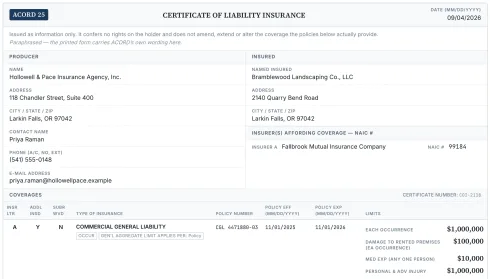 The ACORD 25, filled from the policy on file · open the demo →
Two demonstration sign-ins — either one works.
agent1review-demo-1
agent2review-demo-2
A Desk hands one department its week back. Four to eight workflows that hand off to each other, a knowledge layer that answers from your own documents, and monitoring wired before go-live. It makes your own operation cheaper to run.
A Product is software your business sells to other people. The application, accounts and billing, the AI layer, integrations, deployment — built from nothing and yours outright.
This sounds like a Desk. $20,000–60,000, and the Blueprint will confirm it either way.
This sounds like a Product. $60,000–$150,000+, and the Blueprint will confirm it either way.
Accounts, billing, permissions, error states, and what happens at three in the morning when something breaks.
Five inputs. One band out. Never a quote.
Low$60,000High$70,000
The Blueprint fixes the number.
Every answer adds a floor to the building above. This is a range to think with, not an estimate for your project — the Blueprint is what turns it into one.
This is a thinking aid, not a quote. Nothing you enter here is sent anywhere or saved.
These aren’t a smaller company’s shortcuts. They’re the same standards as everything else on this site, run at ten times the size.
Half an hour and an honest description of what you'd sell.
A straight answer on fit.
You know whether this is worth pursuing at all.
Access to the systems the Product needs to talk to.
The written architecture and the number.
You have an architecture, the integration reality, and a fixed price.
Access to the accounts the Product will live in.
The scaffolding every later phase builds on.
Accounts, environments, and the sign-in and billing layer exist and are reachable.
Answer questions as they come up — this is where scope gets real.
The product itself, built against the architecture.
The workflow your customers came for actually runs, end to end, in shadow.
A small group of real users willing to try it early.
Fixes, not features, until it's solid.
Real users have used it, and the failure modes that only show up under real use are found and fixed.
The decision to go live.
Monitoring wired before go-live.
It's live, monitored, and the run that produces no record gets flagged same as the run that errors.
Run the six phases above and the diagram below is what they build: a request arrives, documents are read and fields are pulled out automatically, and when something’s missing the system stops and hands the file to a person, with the gap marked. The person finishes it. The whole path is watched, including the run that never happened — the same idea every phase above holds, drawn end to end.
A person finishes it.
Including the run that never happened.
A Product costs money after it launches. Three things drive that, and none of them are hidden in a line item you find out about later.
The AI runs per task, and that cost is capped and visible, not open-ended. You see what it’s spending, the same way you’d see a hosting bill.
Hosting runs in your own accounts, billed to you directly, at cost. We don’t mark it up and we don’t take a margin on your infrastructure bill.
Keeping it running day to day is a separate, re-quoted service — not included in the build price and not assumed. Three separate line items, not a bucket of hours: keeping it running, capacity to improve it, and someone on call when it breaks. Two tiers, sized to how much system you actually run. Detailed below.
What’s covered, and what isn’t. A defect in what we built is on warranty. A feature you didn’t ask for at the Blueprint is a change order, quoted before it starts.
Everything else on this page finishes. This is the part that is still going after 7am.
Scenario · illustrative — a picture of a running system, not a measurement of one. No amount is shown because no amount is knowable before the Blueprint.
| Cost | Who pays it | How it’s billed |
|---|---|---|
| AI usage | You | At cost, capped, visible |
| Hosting | You | At cost, in your own account |
| Ongoing operations | You, if you want it | Separate retainer, re-quoted |
| A defect we shipped | Us | Covered by warranty |
| A feature you didn’t scope | You | Change order, quoted first |
The Blueprint is a decision, not a formality. It can say build it, change it, or don’t build it at all.
If it says stop, you’ve spent $6,000 instead of $60,000–$150,000+ — and you keep the document that explains why.
Six things a Product from us will never have. Not settings — absences. The architecture is on the security page.
Thirty minutes on whether what you’d build is a Product at all. If the honest answer is a Desk instead, we’ll say so on the call.